
I Watched Iranian Americans Pack CPAC Halls. Then I Asked Why They Won't Vote.

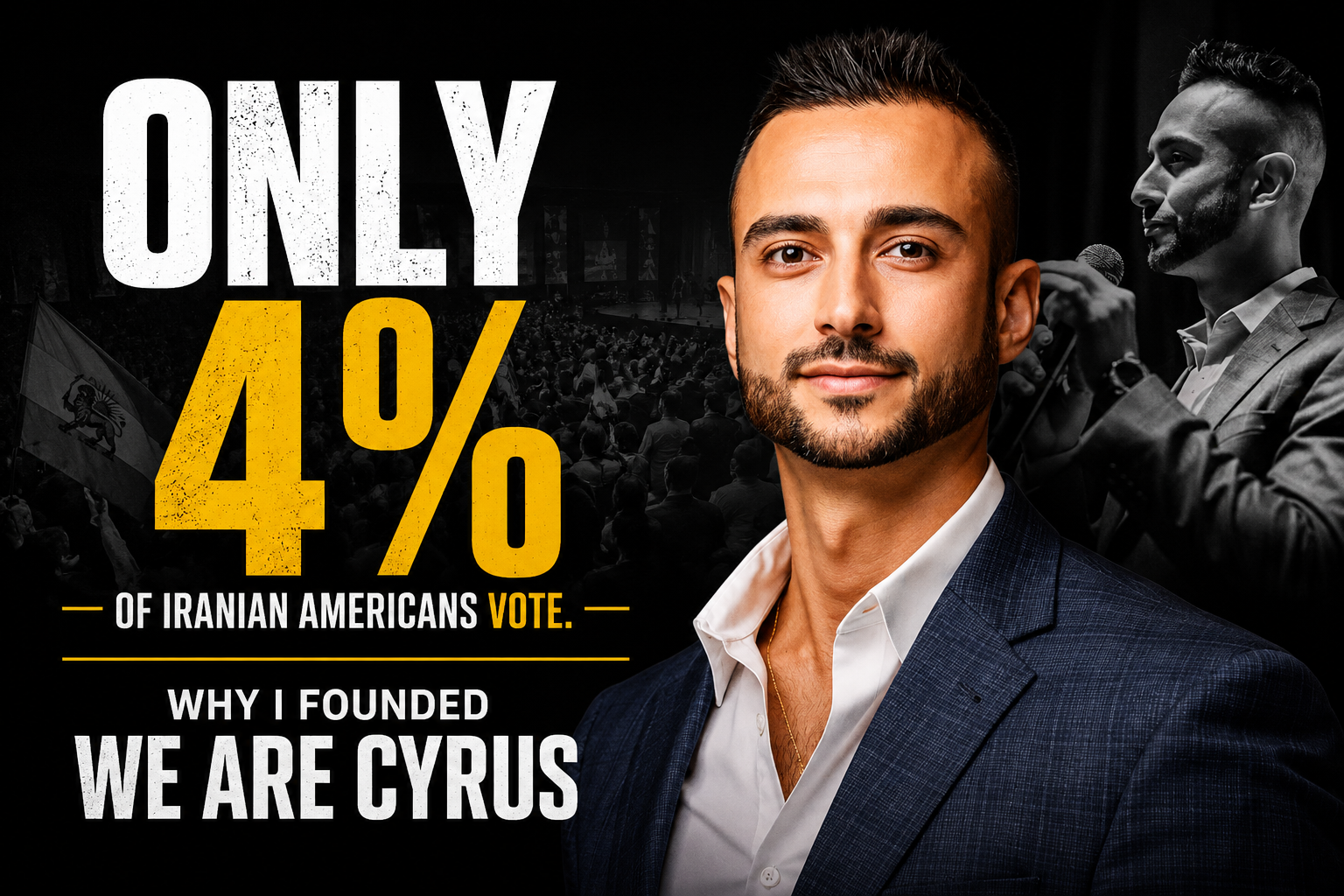
Less than 4% of Iranian Americans vote in U.S. elections.
Let that number settle for a moment. We are talking about one of the most educated, economically successful, and culturally rich diaspora communities in the United States. Iranian Americans have built hospitals, founded companies, led research institutions, and shaped the cultural fabric of this country. And yet, when it comes to the political process that governs nearly every aspect of American life, our community is almost entirely absent.
That statistic is not just a data point. It is a diagnosis. And for me, it is personal.
The Foundation
Everything I am building with We Are Cyrus is rooted in my faith in Christ.
Not in political ambition. Not in a desire for influence or a career calculation. The foundation of this work is the same foundation that governs my life: the belief that the greatest among us is the one who serves. Christ said it plainly, and I have spent years trying to understand what it actually costs to live that way.
Service is not a strategy. It is a calling. And when I look at the Iranian American community, I see a people who were built for it, who have survived things that would break most, who carry a depth of resilience and wisdom that this country has barely begun to benefit from. The question that keeps me up at night is not whether we are capable. It is whether we will choose to show up.
Where I Come From
I was born in Iran into a Bahai family. The Bahai faith is one of the most persecuted religious minorities in the Islamic Republic. Bahais are denied access to higher education, imprisoned for worship, stripped of basic rights in the country of their birth. My family lived that reality. We were forced out of Iran not for what we did, but for what we believed.
America became our refuge. And I understood from an early age that freedom is not something you inherit passively. It is something people bleed for. Something that can be taken away. Something that demands to be protected.
In America, I found Christ. That encounter reorganized everything I thought I knew about purpose and about what a human life is for. It did not make me less Iranian. It did not make me less shaped by everything my family had survived. If anything, it deepened my sense of obligation to the people around me.
I enlisted in the United States Army and served as an infantryman. That decision came from the same place my faith does: the conviction that gratitude without action is hollow. That if this country had given my family safety and dignity, the least I could offer in return was my service.
An Awakening Worth Defending
Something is happening in the Iranian community, and I think it deserves to be spoken about honestly.
Across the diaspora, Iranian Americans are finding faith in Christ in remarkable numbers. It is one of the quiet stories of our generation, an awakening that is happening in living rooms and small churches and online communities, often far from any spotlight. People who grew up under a theocracy that weaponized religion are discovering, sometimes for the first time, what it means to encounter God through grace rather than through fear.
There are those who view this with suspicion. The cynical read is that conversion is a legal maneuver, a way to strengthen a claim for asylum or residency. I understand where that suspicion comes from. But I think it misses something important.
When a people have been governed by a regime that used the name of God to justify oppression, the fact that so many of them are turning toward a different understanding of faith is not a legal strategy. It is a spiritual one. It is people who have seen religion at its worst going in search of something true.
That search deserves respect, not skepticism. And the Iranian Americans walking that road deserve to be seen clearly, not reduced to a caricature.
The Moment That Changed Everything
The moment of clarity for me came at CPAC, the Conservative Political Action Conference, one of the largest political gatherings in the United States. This year, I looked around the room and saw a striking number of Iranian Americans. Not as observers. As participants. Energized, engaged, present.
I want to be careful here, because this is not about politics. People have the right to hold whatever views they choose, and I believe Iranian Americans should be represented across the entire political spectrum. That is actually the point.
What struck me was the contrast. Here were Iranian Americans motivated enough to travel, to engage, to show up for something they believed in. And the overwhelming majority of our community could not be moved to cast a ballot.
If a portion of our community can mobilize around a single conference, why can't we mobilize around the basic act of democratic participation? Why can't we be present at every table, in every conversation that shapes the future of this country?
That question became the founding premise of We Are Cyrus.
Understanding the Silence
The 4% figure is not apathy. It has roots.
Many Iranian Americans came from a country where political participation was not civic engagement. It was survival. The wrong alignment could mean imprisonment. The wrong association could cost a family everything. Generations were taught, rightly in that context, to keep their heads down. To build quietly. To protect what they had.
That instinct followed us here. And for a long time, it made sense. The priority was stability. Education. Building a life. Politics felt like a risk, or at best, a distraction.
But something has shifted. We are no longer a community of new arrivals trying to survive. We are an established presence with deep roots, real resources, and the full legal rights of citizenship. What we have not yet built is political power proportional to our contributions.
That gap has consequences. When a community does not vote, it is not factored into political calculations. When it does not organize, it has no leverage. When it is not at the table, decisions are made without it. The silence that once protected us is now costing us.
Why Cyrus
The name of this organization is not accidental.
Cyrus the Great founded the Achaemenid Empire in the sixth century BCE and issued what many historians regard as the first human rights charter in recorded history. He allowed the peoples he governed to practice their own religions, speak their own languages, and maintain their own cultures. He understood something that many leaders before and since have failed to grasp: that lasting strength does not come from domination. It comes from dignity.
Iranian Americans carry that civilization in their bloodline. We do not have to accept a narrative that reduces us to victims or political pawns or cautionary tales. We come from people who shaped the ancient world. We have something to contribute to this one.
We Are Cyrus exists to help our community remember that. And to act on it.
What We Are Building
We Are Cyrus is not a political party. We do endorse candidates, but not based on party affiliation alone. Our endorsements are earned through a direct process: interviews, question and answer sessions, and a genuine assessment of where a candidate stands on the issues that matter to our community. We built it that way intentionally, because Iranian Americans deserve representation that is accountable, not assumed.
It is a civic infrastructure project built on a simple conviction: that Iranian Americans have both the right and the responsibility to participate in the democracy that protects them.
We are building voter registration programs, leadership pipelines, and coalition partnerships. We want more Iranian Americans on school boards and city councils. More Iranian Americans appointed to commissions and advisory bodies. More Iranian Americans running for office, shaping policy, and contributing to the laws that govern all of us.
But before any of that, we need more Iranian Americans to simply show up.
The Reason
I am not building this because I believe politics will save anyone. I do not believe that. My faith tells me that transformation begins somewhere deeper than any legislature can reach.
But I also believe that faith without works is incomplete. That when you know something is wrong and you have the capacity to change it, silence is not neutrality. It is a choice.
Iranian Americans know what it looks like when freedom disappears. We have lived it. We carry it. And I believe that knowledge comes with an obligation, not just to be grateful for the freedoms we now have, but to actively protect them.
The greatest among you will be your servant.
That is the standard I am trying to live up to. Not perfectly. But honestly. And with everything I have.
That is why I founded We Are Cyrus. And that is why we are just getting started.
Join us at wearecyrus.com. Register. Volunteer. Lead. Show up.
Because the future belongs to those who serve.
Brian Taef
Founder, We Are Cyrus | wearecyrus.com