
Who Owns the End of the Regime in Iran?

I was born in Iran.
I didn’t read about tyranny. I’ve seen it.
And I’ve also worn the uniform of the United States, the country that gave my family a second chance at freedom.
So when I hear people casually debate what should happen next in Iran, I don’t hear policy.
I hear people guessing about a fire they’ve never stood inside of.
Because the situation right now is not complicated.
The regime is weak. The moment is here.
The only question that matters is:
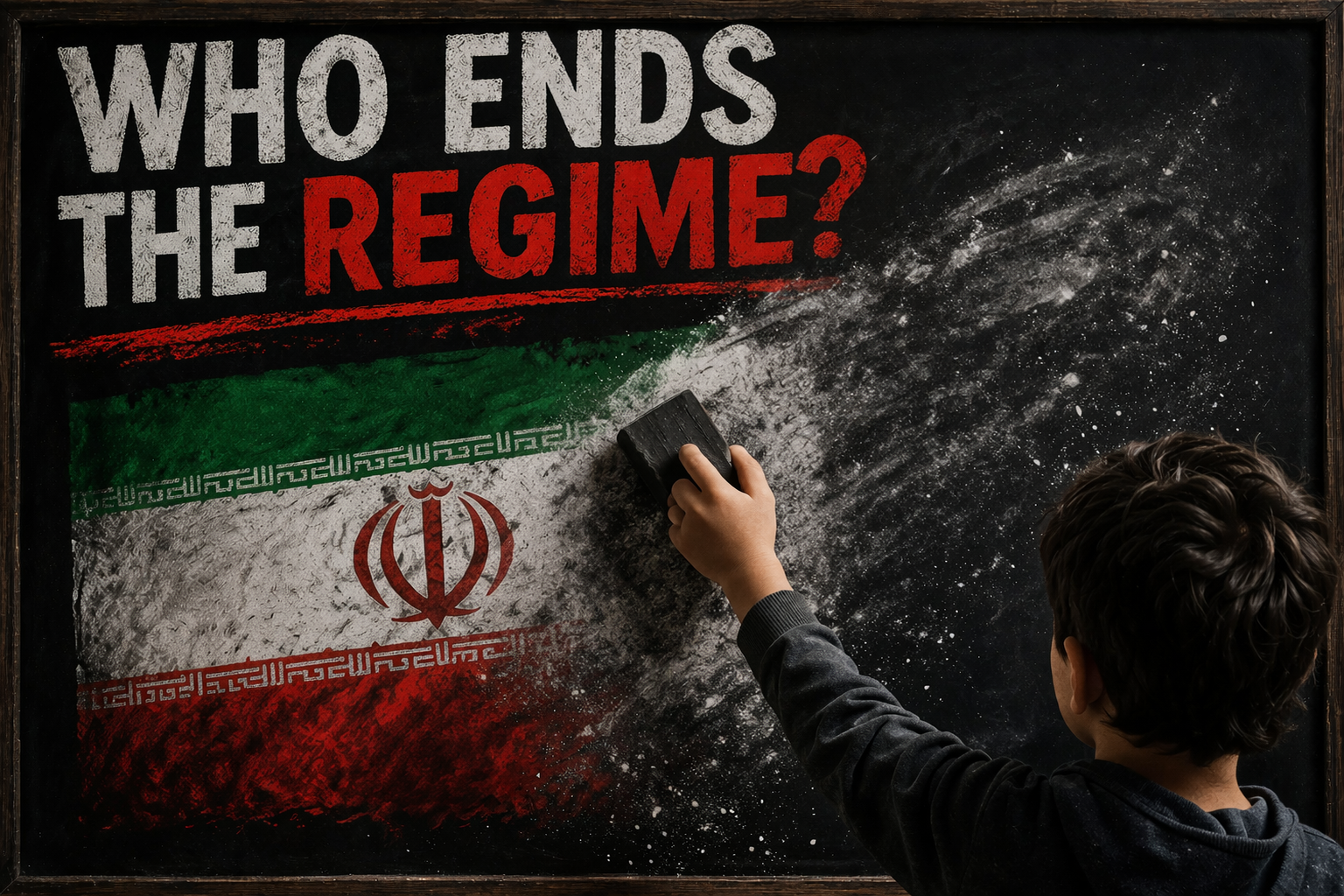
Who owns the end of it?
For decades, the world has defaulted to the same failed playbook.
Send in troops.
Or flood the country with weapons and hope the right side wins.
We’ve seen how that ends.
The Iraq War removed a regime and left behind a fractured state.
The Syrian Civil War turned a revolution into a battlefield of militias and foreign interests.
That is not liberation.
That is chaos wearing the mask of freedom.
Iran will not survive that outcome.
But let’s stop pretending the alternative is peace.
The Iranian people were already living in collapse before a single shot was fired, before the latest uprising ever began.
Power cuts so constant families couldn’t keep food in their refrigerators.
Water shortages in one of the most resource-rich countries in the region.
This wasn’t mismanagement.
This was a regime choosing to redirect resources away from its own people while pursuing its own priorities.
And that reality is exactly what pushed people into the streets.
This uprising didn’t come out of nowhere.
It came from years of pressure finally reaching a breaking point.
So no, the question is not whether people will suffer.
They already are.
The question is whether that suffering continues under the regime…
or becomes the moment they take their country back.
And this is where most analysts get it wrong.
They assume if the regime falls, Iran falls with it.
That chaos is inevitable. That a vacuum is unavoidable.
That might have been true before.
It is not true today.
Because for the first time in 47 years, there is something different:
There is a plan.
Backed by Reza Pahlavi and a network of policy, economic, and security experts, the Iran Prosperity Project lays out a real transition.
Not slogans.
Not hope.
Execution.
- A defined first 100 to 180 days focused on stabilization
- A structured transitional authority to maintain order
- A national referendum where Iranians choose their future system
- A constitutional process leading to an elected government within roughly two years
This is exactly what Iraq didn’t have.
It’s exactly what Syria never built.
And it changes the equation.
There is also another risk that cannot be ignored.
Not every opposition movement is positioned to deliver stability.
Figures such as Maryam Rajavi and organizations like the MEK present themselves as alternatives, but their history and structure raise serious questions about long-term legitimacy and governance.
This is not about personalities.
It’s about outcomes.
Iran does not need to replace one unstable power structure with another under a different name.
This is not about restoring a monarchy.
Let’s be clear.
Pahlavi himself has repeatedly said the future system will be decided by the people, whether that is a republic or a constitutional monarchy similar to those in Europe.
This is about something far more important:
Preventing Iran from breaking apart the moment the regime collapses.
Because history doesn’t reward revolutions that win the streets but lose the transition.
Now let’s talk about the role of the United States.
Because this is where the conversation usually goes off track.
Full-scale invasion?
We’ve done that. We paid for it in blood and time.
Blindly arming groups inside Iran?
That creates militias, not nations.
Doing nothing?
That leaves the future of Iran in the hands of the IRGC.
There is a third path.
Support the fall. Don’t own it.
And yes, pressure will hurt.
But let’s stop pretending the current situation is stable.
The Iranian people have been living under pressure for decades.
The difference now is this:
For the first time, that pressure is not just being absorbed by the people.
It is being directed at the regime itself.
That shift did not happen by accident.
Under Donald Trump, the pressure campaign began targeting the regime’s core power structure, not just the population around it.
And now, those cracks are visible.
That matters.
Moments like this don’t come often.
And they don’t last.
There are also signs coming from inside the system.
According to Reza Pahlavi, tens of thousands of individuals connected to Iran’s government, military, and security apparatus have engaged with efforts to prepare for transition.
If that holds, it points to something critical:
This is no longer just a protest movement.
This is the early stage of internal fracture.
And when that happens, regimes don’t reform.
They fall.
So let’s be clear about the objective.
The United States should not remove the regime for the Iranian people.
And it should not repeat past mistakes by stepping in without a viable internal transition.
But it also cannot allow either regime survival or uncontrolled collapse to dictate the outcome.
The objective is alignment:
An internal uprising with structure.
A transitional framework already in place.
External pressure that weakens the regime without replacing the people.
When those three align, outcomes change.
If the Iranian people move to take back their country with coordination and leadership behind them,
then the role of the United States is not to lead that movement.
It is to make sure it succeeds.
Because the end is coming.
That’s no longer the question.
The question is:
Who owns it?
The world?
Or the people of Iran.