
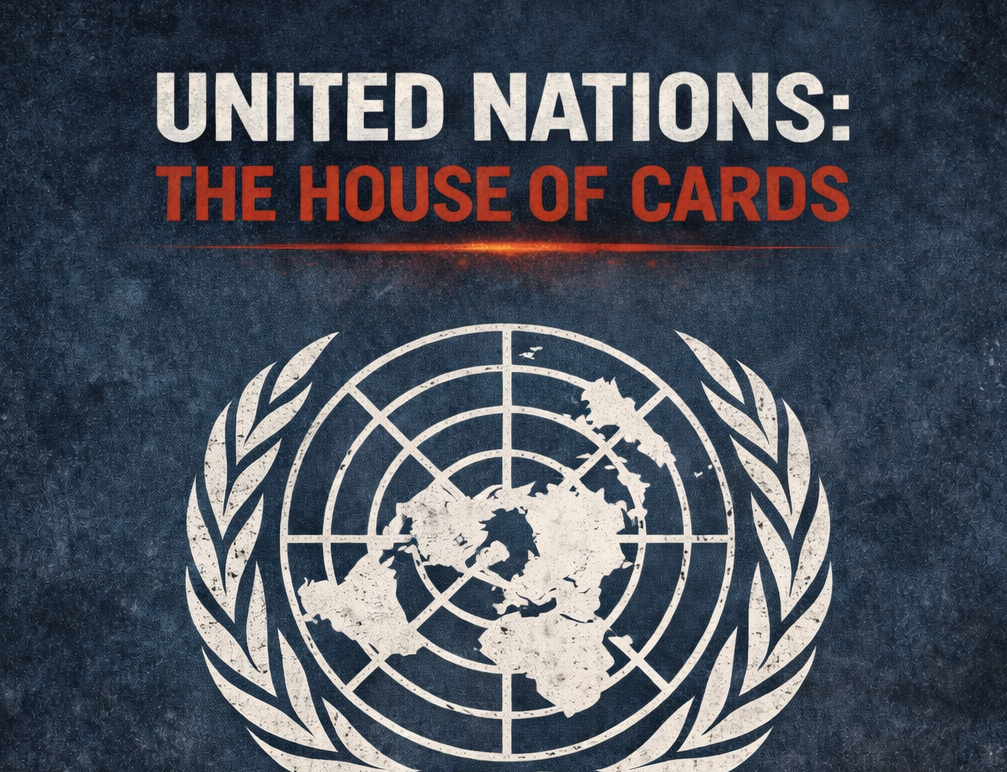
United Nations: The House of Cards?

The United Nations was founded on a promise forged in blood.
After the Holocaust.
After global war.
After the world witnessed what happens when evil meets hesitation.
“Never again” was meant to be more than a slogan.
It was meant to be a safeguard.
But safeguards require mechanisms. And the central mechanism of the United Nations was built not primarily for moral enforcement — but for geopolitical balance.
The Lesson of Rwanda
In 1994, approximately 800,000 people were slaughtered in Rwanda in the span of about 100 days.
The world knew.
United Nations peacekeepers were on the ground. but they were constrained by mandate, under-resourced, and politically unsupported. Requests to reinforce them were delayed. Warnings were debated.
The killing moved faster than the diplomacy.
Rwanda became the modern symbol of what happens when the world hesitates.
It was supposed to change everything.
In response to that failure, the international community later adopted the doctrine of Responsibility to Protect. The idea was simple: sovereignty should not shield mass slaughter.
But here is the uncomfortable truth.
Even under R2P, meaningful enforcement still requires Security Council authorization.
Which means it still requires the approval of the veto powers.
And that is where the system freezes.
The Structure That Defines Everything
At the heart of the United Nations sits the Security Council.
Five permanent members hold veto power:
The United States
The United Kingdom
France
Russia
China
Any one of them can block enforcement action entirely.
Not revise it.
Not delay it.
End it.
This was not a flaw. It was the price of participation. The great powers agreed to join only if they retained the ability to shield their strategic interests.
The UN was designed to prevent another world war between major powers.
It was not designed to override them.
Stability Over Justice
This is the core tension.
The United Nations prioritizes stability among powerful states over justice for vulnerable populations.
That does not mean it has no value. It has helped reduce direct confrontation between nuclear-armed nations. It coordinates humanitarian aid. It creates diplomatic channels.
But it does not guarantee accountability for regimes protected by veto power.
And that distinction is everything.
Because moral authority without enforcement is fragile.
The Recent Bloodshed in Iran
In the last two months, Iran has experienced one of the most violent crackdowns in its modern history.
Nationwide unrest was met with force. Reports from opposition networks, leaked hospital data, and international monitoring groups estimate the death toll has reached into the tens of thousands. Some sources cite figures exceeding 30,000. President Trump has publicly referenced numbers as high as 32,000 when describing the regime’s brutality.
Whether one accepts the highest estimates or not, the scale of repression is undeniable.
The United Nations has condemned the violence.
It has convened discussions.
It has authorized investigations.
But enforcement through the Security Council would almost certainly face vetoes from permanent members aligned with Tehran.
So the system condemns.
And stops.
Rwanda showed what happens when the world hesitates in the face of slaughter.
Today, hesitation has been institutionalized.
The Pattern Beyond Iran
Iran is not an isolated case.
Uyghur Muslims detained in mass internment systems in western China. Falun Gong practitioners persecuted for decades. Religious institutions pressured to align with state ideology.
Investigations occur.
Reports are written.
But enforcement?
China holds veto power.
Syria followed the same blueprint. Years of civil war. Chemical weapons deployed. Veto after veto.
Authoritarian regimes understand the structure of the United Nations better than many Western commentators do. They know that as long as a veto-holding power shields them, accountability weakens dramatically.
The veto is not merely procedural.
It is strategic armor.
Is Anger Irrational?
There is nothing unreasonable about justified anger.
Anger detached from fact becomes noise. But anger grounded in structural reality becomes clarity.
“Never Again” was a promise made after genocide.
If tens of thousands can die within weeks under a regime, and the global body tasked with maintaining peace remains structurally unable to act, then questioning that structure is not radical.
It is rational.
The House of Cards
Emergency sessions are held.
Statements are issued.
Committees are formed.
But when enforcement requires unanimous agreement among rival superpowers, the machinery stalls.
The appearance of action remains.
The mechanism does not move.
That is why calling the United Nations a house of cards is not emotional exaggeration.
It is structural observation.
The façade suggests universal moral authority.
The foundation rests on veto power.
And until that architecture changes, the United Nations will continue to function as it was designed:
A stabilizer of great powers.
Not a guarantor of justice.