
The Space Between Capitals: How Britain’s Caution Strengthens Tehran

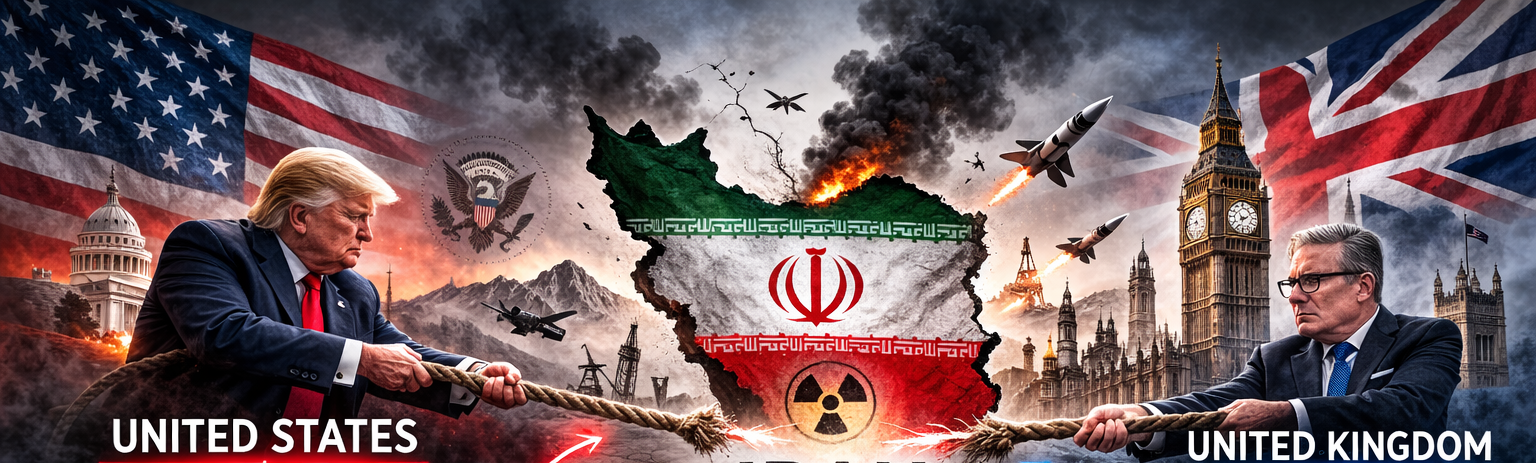
The Islamic Republic does not survive because it is loved.
It survives because its adversaries hesitate.
And right now, that hesitation is coming from London.
As Washington escalates pressure on Tehran, the United Kingdom is signaling restraint. The divergence is being framed as legality, prudence, and alliance management. But beneath that language lies something more consequential: a widening strategic rift over what to do about the Islamic Republic.
This is not about diplomatic nuance. It is about power.
The United States under President Trump is signaling coercive leverage. Deadlines. Escalating rhetoric. Credible force as negotiation backdrop. The logic is simple: negotiations without pressure are theater. Tehran moves only when it calculates cost.
London is operating under a different doctrine. Legal caution. Coalition optics. Risk containment. The refusal to pre-authorize the use of Diego Garcia for potential U.S. operations against Iran is being defended under international law.
Legally, Britain has standing. Diego Garcia sits on British sovereign territory. Use of force requires justification. The UK insists that any preemptive strike must meet a clear self-defense threshold.
Fine.
But geopolitics is not conducted in footnotes.
Diego Garcia is not just a runway in the Indian Ocean. It is one of the most strategically important bomber and logistics platforms in the region. When London signals hesitation over access, Tehran reads that signal. It does not parse legal doctrine. It parses unity.
And unity appears fractured.
This fracture does not exist in a vacuum.
Britain enters this moment navigating its own institutional turbulence. The fallout from the Jeffrey Epstein scandal continues to cast a shadow over British elite credibility. Questions about proximity, judgment, and institutional insulation have not fully dissipated. Governments under reputational strain often move cautiously abroad. When authority is fragile at home, appetite for high-risk foreign entanglements narrows.
Add to this the upcoming visit of the King to the United States. Royal visits are choreographed displays of stability and continuity. Visible strategic discord between Washington and London over Iran complicates that image. Diplomacy is theater layered over power, and when the stage is delicate, boldness is often softened.
Tehran notices.
This is not an accusation that Britain supports the Islamic Republic. It does not. London has sanctioned Iranian officials and condemned repression. But sanctions without consistent enforcement become symbolic. Designations are announced. Lists expand. Yet oil continues to move through shadow fleets. Financial intermediaries adapt. Enforcement gaps dilute deterrence.
Sanctions on paper are not strategy.
The deeper issue is strategic appetite.
The United States is signaling that Iran’s nuclear posture, regional militia network, and repression at home cannot be indefinitely managed through process. The UK is signaling that escalation must remain tightly constrained within legal architecture.
History suggests that divergence carries cost.
In 1970s, Iran was a pillar of American regional strategy under President Richard Nixon. The Nixon Doctrine treated Tehran as an anchor in the Gulf. Then Watergate fractured Washington. Strategic clarity eroded. Domestic trauma shifted focus inward. By the late Carter years, confidence in the Shah had weakened. Human rights pressure increased. Elite cohesion fractured.
There was no master conspiracy installing Ayatollah Khomeini. There was miscalculation. Fragmentation. Underestimation of ideological consolidation.
Meanwhile, Khomeini’s messaging reached Iranian households through expanding media channels. Revolutionary momentum scaled while policymakers debated.
The West did not orchestrate 1979. It hesitated into it.
The result reshaped the Middle East for nearly half a century.
Today’s environment is different, but the structural lesson remains.
The Islamic Republic understands Western systems intimately. It knows the UN Security Council is paralyzed by veto power. It knows that Responsibility to Protect is a principle without enforcement absent unanimous agreement. It knows that legal caution in allied capitals slows momentum. It calibrates escalation accordingly.
When Washington leans forward and London leans back, Tehran gains time.
Time is strategic currency.
Britain’s defenders will argue that caution prevents reckless war. That legality matters. That alliance cohesion cannot be sacrificed for unilateral posture.
Those arguments have merit.
But so does the counterpoint: deterrence without unity erodes credibility. Pressure without transatlantic alignment weakens leverage. And regimes built on survival instinct thrive in ambiguity.
This is not about warmongering.
It is about clarity.
If the West intends to manage Iran indefinitely through sanction lists and carefully worded statements, then it should admit that openly. If it intends to escalate pressure to force structural concessions, then unity must precede rhetoric.
Tehran is not confused.
It reads the divergence. It watches British legal positioning. It calculates American deadlines. It understands that enforcement inconsistencies reduce economic pain. It recognizes that internal Western distractions narrow strategic appetite.
The Islamic Republic has survived revolutions, economic isolation, internal unrest, and regional conflict.
Its most consistent advantage has not been military superiority.
It has been Western division.
In 1979, fragmentation altered the Middle East.
In 2026, the question is not whether Britain is legally correct.
The question is whether strategic caution, layered atop reputational vulnerability and diplomatic choreography, once again creates the space in which Tehran consolidates.
The space between capitals is not abstract.
It is operational terrain.
And right now, that terrain is widening.
History does not require conspiracy to produce consequence.
It requires hesitation at the wrong moment.